

Functional Toppers
Puppy Training
Puppy Stage


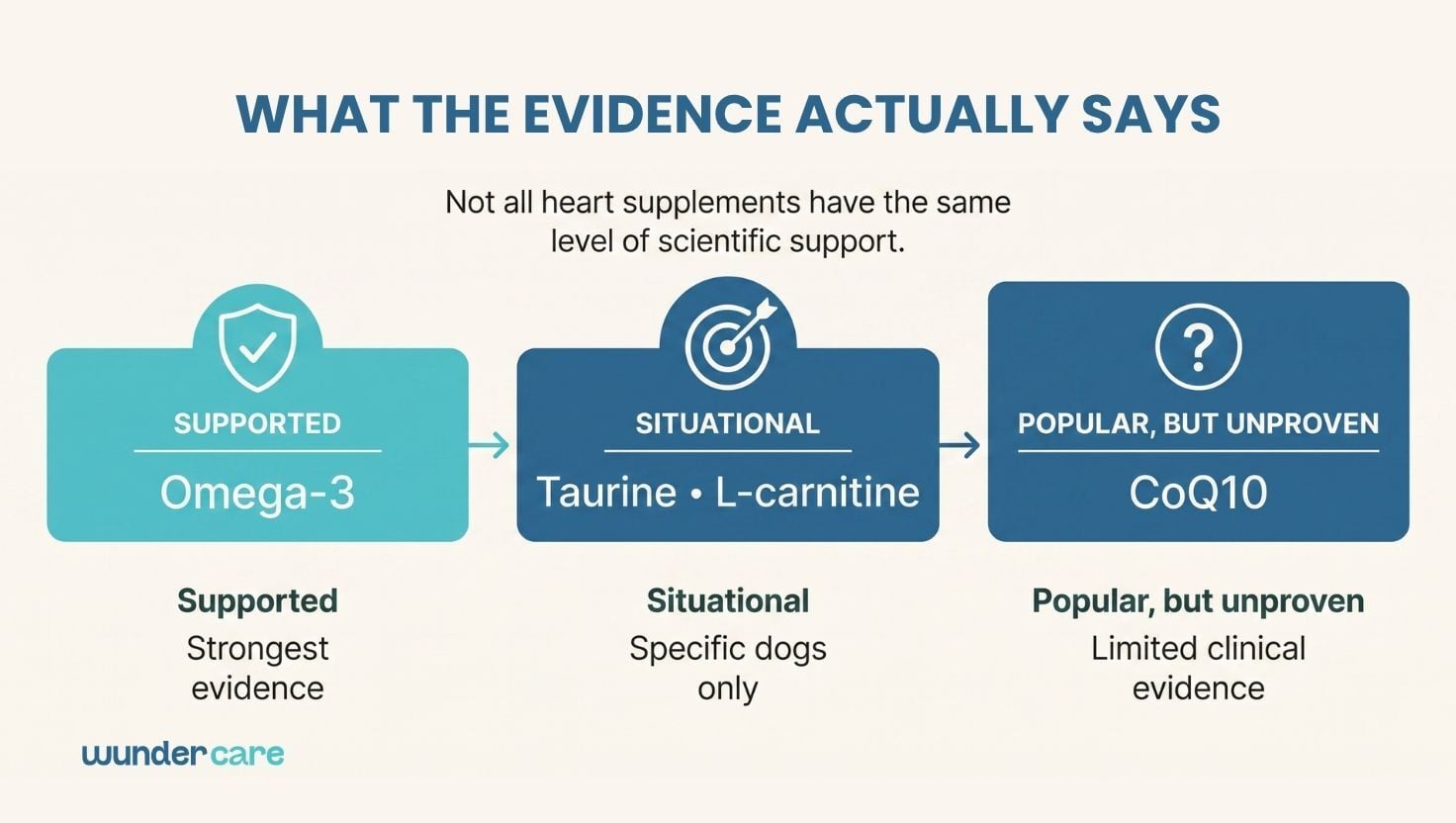
Quick version: of all the heart supplements you'll see marketed for dogs, omega-3 fish oil has the most real science behind it, taurine and L-carnitine genuinely matter but mostly for specific breeds and diets, and CoQ10 is popular and safe but hasn't been shown to actually improve heart disease in dogs. And none of them replaces the one thing that does the heavy lifting: a complete, balanced diet.
Let me walk you through what's worth your money and what isn't, the way I would across the table, because the marketing around this stuff is honestly a bit of a jungle.
Here's the thing most supplement pages won't tell you. A complete, balanced diet from a company that actually tests its food already contains the vitamins, minerals, and nutrients your dog needs, in the right amounts. The global veterinary nutrition guidance is blunt about it: there's usually no need to pile supplements on top of a proper diet, and some nutrients are genuinely harmful in excess. So the honest starting point isn't “which supplement,” it's “is the diet right first.” Supplements are the supporting cast, never the lead. If you want the full picture on feeding an aging heart, I covered it in What to Feed Your Senior Dog to Support a Healthy Heart.

If you only pay attention to one, this is it. The omega-3 fatty acids EPA and DHA, the kind from fish oil, have the strongest research behind them for canine hearts. Studies have shown that dogs in heart failure tend to have low levels of these fats, and that supplementing them can calm the inflammation that comes with heart disease, help preserve muscle (dogs with failing hearts often waste away, something vets call cardiac cachexia), and even reduce certain irregular heartbeats, that last one shown nicely in a study of Boxers. So this isn't hype: it's genuinely useful support, and it helps the appetite and coat too.
The catch: quality and amount matter, and more is not better. Cheap or oxidised oils can do the opposite of what you want, and there's a real upper limit before fish oil starts thinning the blood. So this is one to get from a good diet or to add under your vet's guidance at the right amount, not to free-pour from a bottle. We wrote more about the right kind of fat in Omega-3s for Dogs: Why Fat Isn't the Enemy.
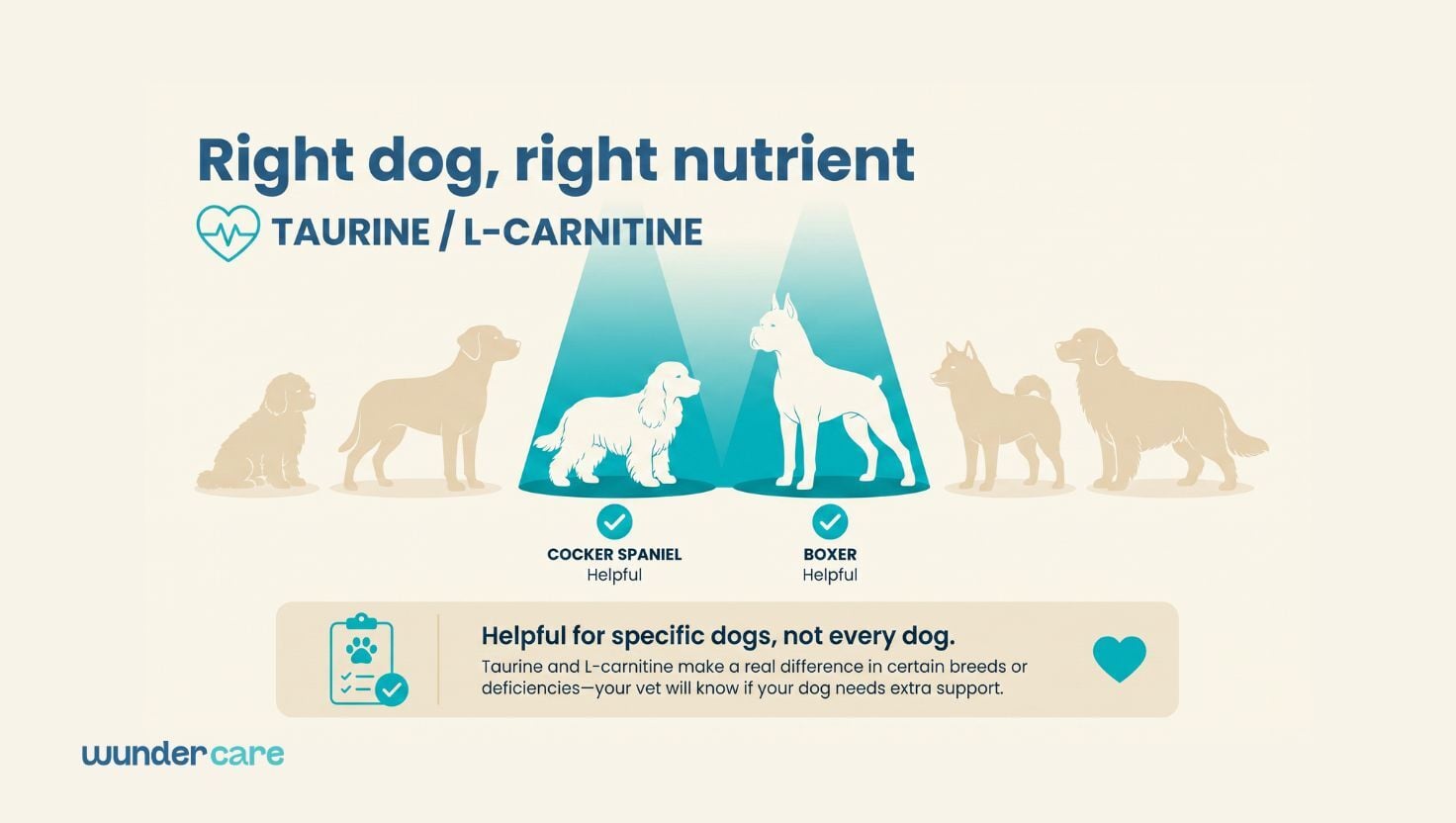
Taurine is an amino acid that heart muscle relies on. Most dogs make plenty themselves, so the average dog on a good diet doesn't need extra. But in some dogs it's a different story. A classic trial in American Cocker Spaniels found that dogs of that breed with dilated cardiomyopathy (DCM) were taurine-deficient, and that supplementing taurine (with L-carnitine) improved their hearts enough that many could come off their heart medications. Certain other breeds and certain diets can run low too. So taurine is powerful in the dogs who actually need it, and largely pointless in the ones who don't, which is exactly why it's a test-and-treat nutrient your vet guides, not a blanket add-on.
L-carnitine helps heart cells turn fat into energy. Its clearest role is in a family of Boxers with a carnitine-deficient cardiomyopathy, where supplementation brought some improvement, and in those Cocker Spaniels alongside taurine. Outside those specific situations, it hasn't been shown to be a general heart booster. So, like taurine, it's genuinely helpful in the right patient and not a must-have for everyone, a decision for your vet based on breed and testing rather than a shelf you grab on the way out.
CoQ10 (coenzyme Q10) is everywhere in the supplement aisle, and it's a reasonable idea on paper: it's an antioxidant involved in how cells make energy, and it's been studied a lot in people. But here's the honest part. The best study we have in dogs, a proper randomised, placebo-controlled trial in dogs with mitral valve disease, found that CoQ10 was safe and well tolerated, but did not improve heart function, the ultrasound measurements, or the cardiac blood markers. The only hint of benefit was a small anti-inflammatory effect in the dogs already in heart failure, and even the authors said larger, longer studies are needed. So my honest take: it's popular, it's biologically plausible, it's safe, but it has not been shown to actually change the course of heart disease in dogs. If it were my own dog, I'd spend the money on the diet and the omega-3s first.
Because it always comes up: the concern being studied is a form of diet-associated DCM linked to diets high in pulses (peas, lentils, chickpeas, beans), and current understanding is that it's about those ingredients rather than simply being “grain-free,” and it's mostly not a taurine problem. The science is still evolving and no single cause is proven yet, but many affected dogs improve when the diet is changed. The practical takeaway isn't panic, it's this: feed a diet from a company that does real nutritional testing, and raise your specific food with your vet rather than reaching for a taurine bottle to “cover” a pulse-heavy diet.
Get the diet right first, that's the whole foundation. Make sure your dog is getting good-quality omega-3s, from the food or added sensibly. Leave taurine and L-carnitine to your vet's judgement, because they're breed- and case-specific, not everyday add-ons. And treat CoQ10 as optional and unproven rather than essential. Above all, run any supplement past your vet before adding it, especially if your dog is already on heart medication, because “natural” doesn't mean “no interactions.” Food supports the heart, medicine treats the disease, and supplements, at their best, play a small supporting role for the right dog.
If you'd like help working out what, if anything, your own dog actually needs, our vet team is a message away.
Related reading: Cavalier Heart Disease: Signs, Prevention & Care