

Summer
Dog Cardiac Health
Senior Dog Health


Here's the short version: your dog's heart murmur grade (a number from 1 to 6) tells you how loud the murmur is, not how sick their heart is. A soft grade 2 can sit on top of real disease, and a booming grade 5 can belong to a dog who feels completely fine. So when your vet says “grade 3,” take a breath. It's a clue, not a countdown.
Let me explain what those numbers actually mean, and what to do next.
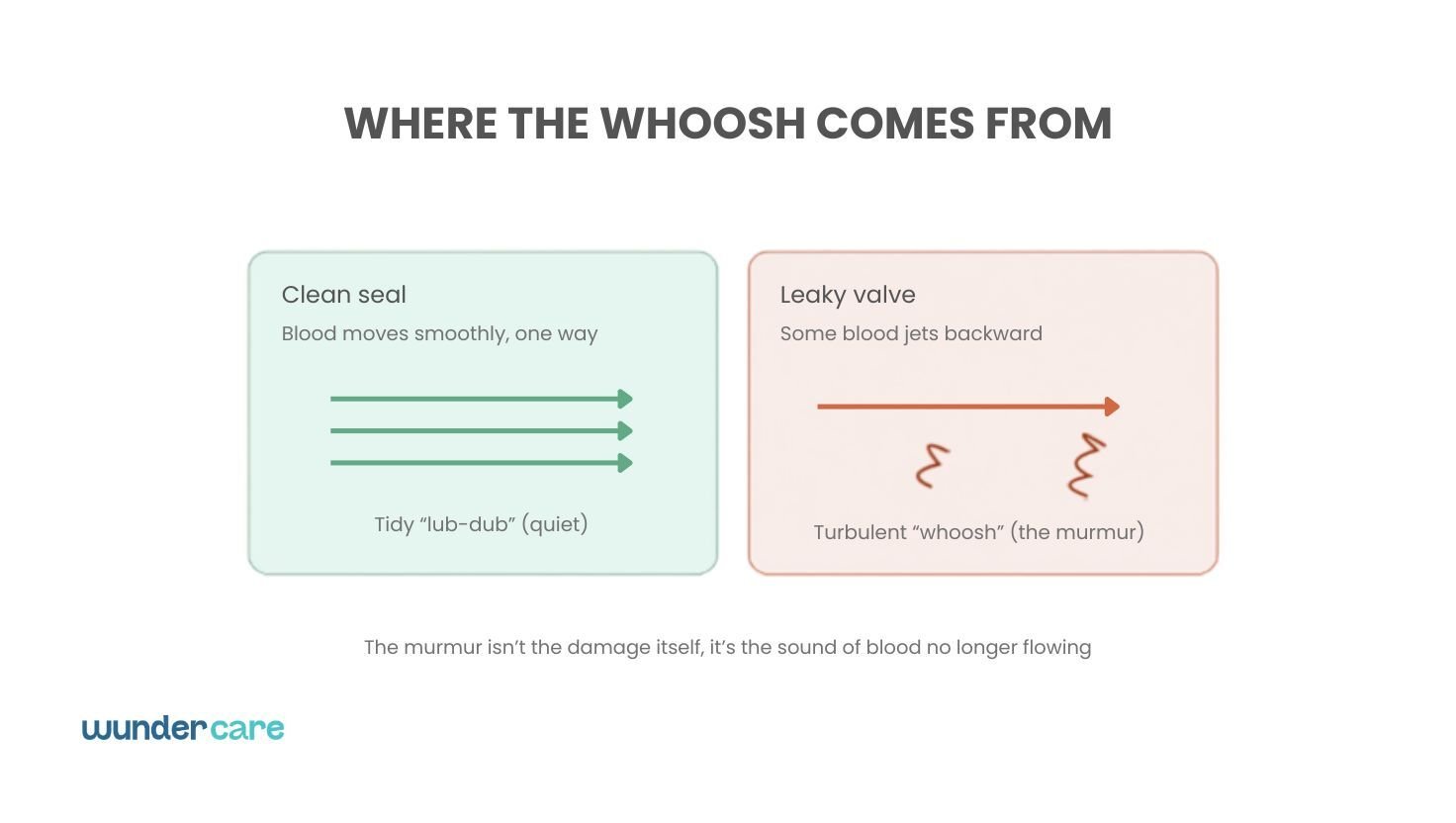
A heart murmur is just a sound. Normally a heartbeat is a tidy “lub-dub.” A murmur is an extra whooshing noise your vet picks up through the stethoscope, made by blood moving turbulently instead of smoothly, usually because a valve isn't sealing perfectly. In older small dogs the usual culprit is degenerative mitral valve disease. If you want the early-signs backstory, I covered it in Small Breed Heart Disease in Dogs: The Early Signs Most Owners Miss.
The grade is simply how loud that whoosh is. Vets use a 1-to-6 scale (yes, it stops at 6, not 10, your dog isn't auditioning).
Grade 1: so faint your vet has to stand in a silent room and really hunt for it.
Grade 2: soft, but there without much searching.
Grade 3: moderate, easy to hear straight away.
Grade 4: loud, clearly there the moment the stethoscope lands.
Grade 5: loud and you can feel it, a buzz (a “thrill”) through the chest wall with a flat hand.
Grade 6: so loud your vet can hear it with the stethoscope lifted slightly off the chest. Rare, and dramatic.
Roughly: 1 to 2 is quiet, 3 to 4 is medium, 5 to 6 is loud enough to feel.
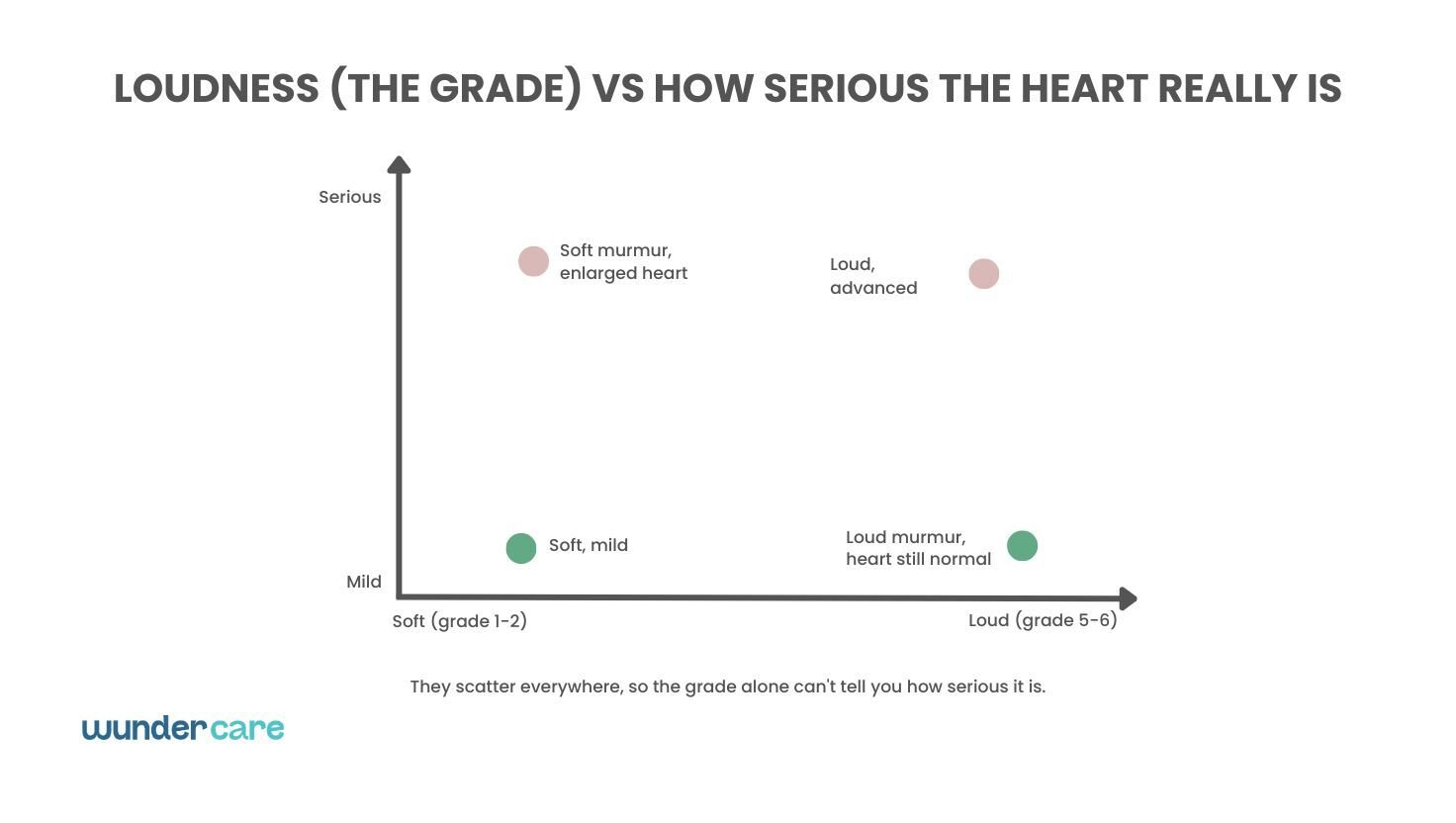
This is the part most owners get wrong, and honestly it's the whole reason I wanted to write this. The grade measures volume, not damage. Loudness depends on all sorts of things: how fast blood is moving, your dog's chest shape, even how wound-up they were on the table. A nervous Chihuahua with a racing heart can produce a louder murmur than a calm dog with more advanced disease.
There is a rough tendency for louder murmurs to go with bigger valve leaks in mitral valve disease, but “rough tendency” is doing a lot of heavy lifting in that sentence. It's nowhere near reliable enough to judge your dog's heart on sound alone. That's why the grade never gets the final say.
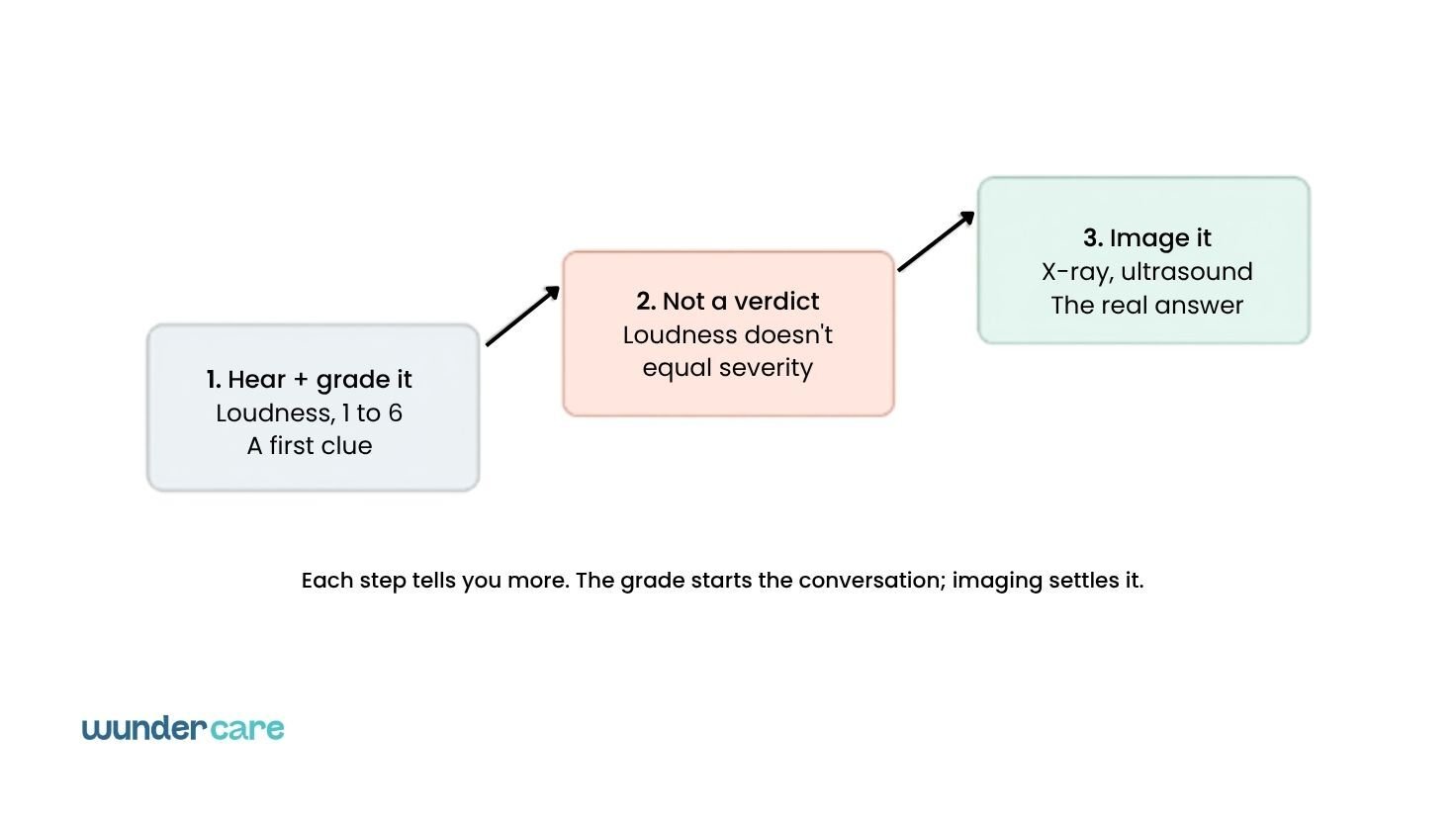
Pictures, basically. To see what's really going on, your vet looks at whether the heart has changed shape and whether fluid is backing up:
A grade 2 murmur with an enlarged heart on X-ray matters more than a grade 5 with a heart that still looks perfectly normal. The number opens the conversation; the imaging finishes it. If you're wondering where all this leads long term, I get into it in How Long Can a Dog Live With a Heart Murmur or Mitral Valve Disease?.
Sometimes, yes. Puppies can have “innocent” murmurs, usually soft grade 1 to 2 hums that mean nothing and typically fade on their own within the first few months as they grow. Those are the happy ones. In an adult or senior dog, though, a new murmur always deserves a proper look, even a quiet one.
First, don't spiral. A grade on its own is not a diagnosis. Then, the practical stuff:
Ask your vet what the next step is (usually imaging, or a monitoring plan). Start a home habit: count your dog's breaths while they sleep. Under 30 a minute is the reassuring zone, and a steady climb over several days is your early-warning system.
Keep your dog lean. Extra weight makes the heart work harder for no reason, and if you're not sure where your dog sits, Is Your Dog Overweight? Signs, Risks & Solutions walks you through it.
Feed to support, not to “fix.” No food repairs a valve, but a balanced, sensible-sodium diet with good omega-3s eases the load. I explained why the right kind of fat is a friend here in Omega-3s for Dogs: Why Fat Isn't the Enemy, and how food supports specific conditions in Therapeutic Dog Food: How Nutrition Supports Health Conditions.
One local note: heat piles extra work onto any heart. If your dog has a murmur, walk in the cool early mornings or late evenings, keep water within reach everywhere, and skip the midday sauna we generously call summer. A grade 3 dog can live a totally normal life here. They just do their zoomies before 7am.
A murmur grade is a volume dial, not a verdict. One to six tells your vet how loud, imaging tells them how serious, and the two together (plus what you do at home) tell the real story. So if your dog comes home with a “grade 3” on their file, don't read it as a sentence. Read it as the start of a plan, and most of that plan is stuff you can absolutely handle.
If you'd like a set of eyes on your own dog, our vet team is a message away.