
Canine Health Conditions
Dog Cardiac Health
wundercare

In a nutshell: a cat's gut does better on high-moisture, gently cooked, meat-forward food than on dry kibble, mainly because cats are obligate carnivores built for exactly that kind of digestion, not because “fresh” is a magic word. That's the whole idea behind Wundercat.
Let me explain why the biology actually backs this up.
Cats are obligate carnivores. They need animal-derived protein and nutrients like taurine and arachidonic acid that they genuinely cannot make themselves, no matter how well-formulated the plant matter around them is. Their whole digestive system evolved around meat, not grain, which is why a food built meat-first tends to sit better than one engineered around cheap carbohydrate fillers.
Here’s the part that surprises most owners. Cats descend from desert animals with a naturally weak thirst drive, they simply don’t compensate at the water bowl the way dogs do. Dry kibble is roughly 10% moisture. Fresh, gently cooked food runs 72 to 74%. That gap matters for the gut specifically, not just hydration in general, more moisture in the meal means gentler, more complete digestion and less strain moving through the gut. In our climate, that gap matters even more.
Kibble is made under high heat and pressure, which measurably degrades amino acid availability and can make proteins harder to break down efficiently. Gently cooked food skips that damage, which is a big part of why palatability and digestibility both tend to be better, especially in cats who are already fussy or recovering from a GI upset.
Cats are notoriously particular, and food neophobia is real, not a personality flaw. A texture or aroma switch that's too sudden can get rejected outright, no matter how good the nutrition is on paper. The fix isn't forcing it, it's a slow transition over a week or two, mixing in gradually increasing amounts alongside the current food, letting the aroma and texture become familiar rather than alarming.
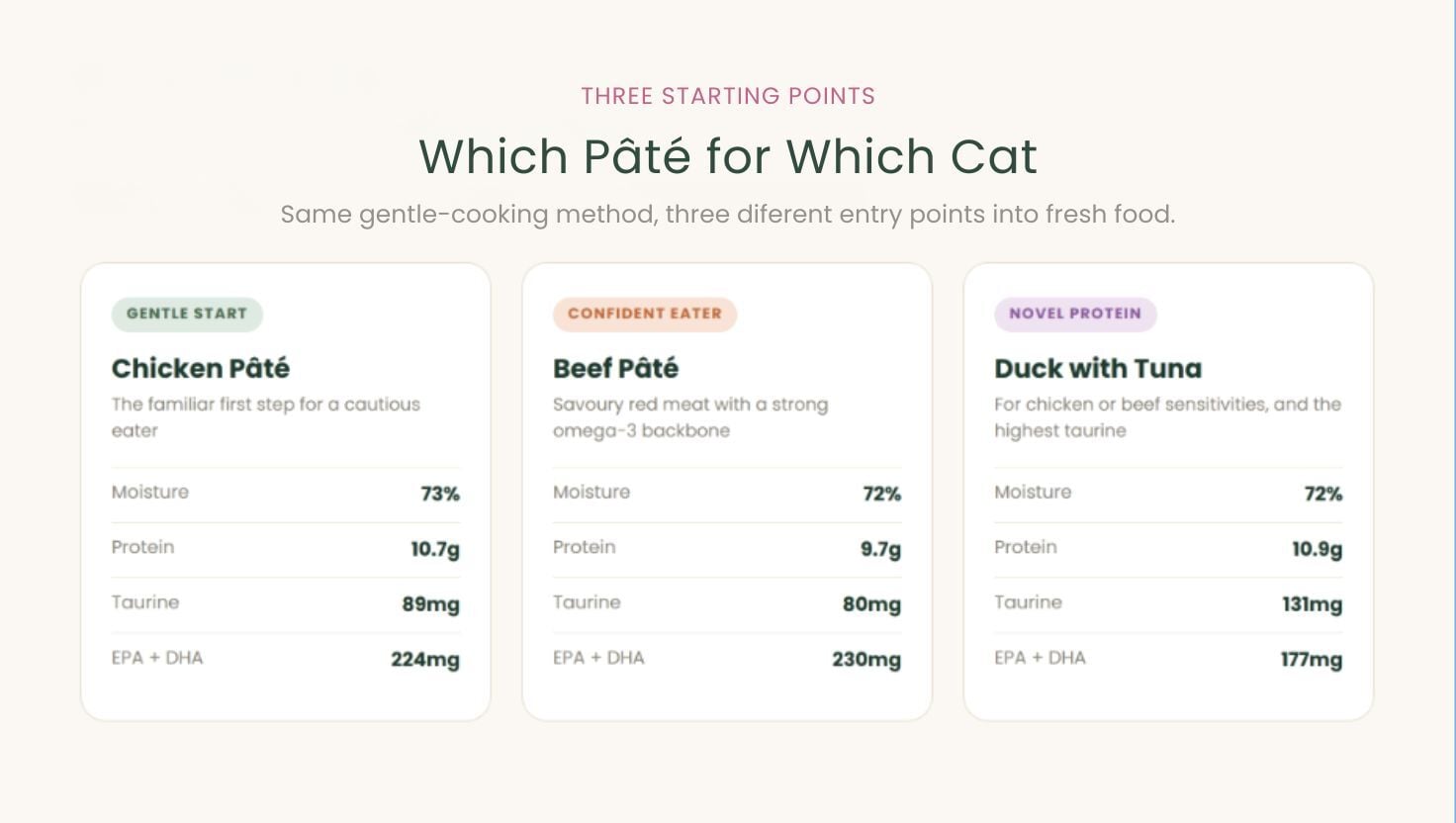
This is exactly why we built the Wundercat range around familiar proteins first. Chicken Pâté is the gentle first step, 73% moisture, 89mg of taurine per pouch, built to be the least intimidating entry point for a cautious eater. Beef Pâté suits a more confident, meat-driven cat. Duck with Tuna Pâté is the novel-protein option, useful if chicken or beef sensitivities are part of the picture, and it happens to carry the highest taurine of the three. None of them are trying to be the whole gut-health solution on their own, they're matched to where a particular cat actually is, picky or confident, sensitive or not.